Insitu-Intuito #1
with AAMSO Eli

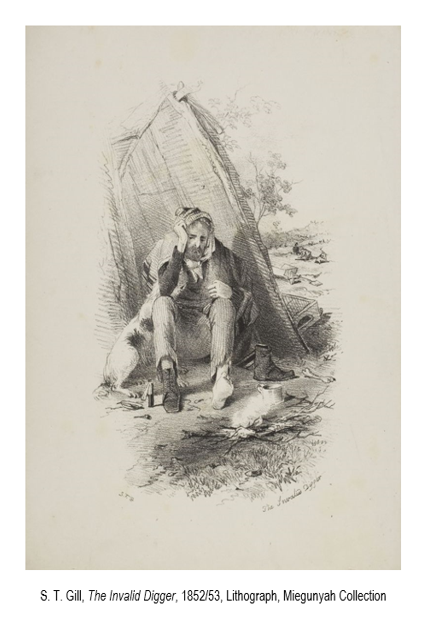
| Site | Miegunyah 1 |
| Batch | 1 |
| Artefact | A |
| Format | Lithograph |
| Source | S. T. Gill |
| Title | The Invalid Digger |
It was the title of this work that first caught my attention, before anything else. Specifically, it was that word.
Invalid.
Though it’s long fallen out of usage in this context, it still seems to link us, this ‘digger’ and me. The centuries between us felt inconsequential when I felt that spark of recognition, the hollow ache in my chest.
Because I knew, that had I been in his place, that word would be used without hesitation to describe me too.
The etymology of the word is as follows:
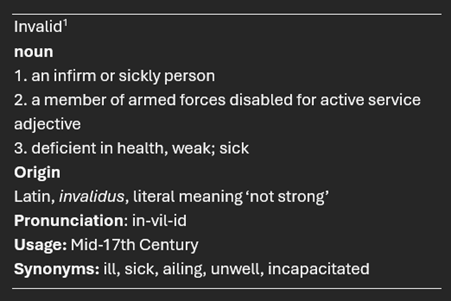
Not to be confused with:

Though some confusion would be understandable, considering the second definition was the original.
This is just one of the many words that have been used to describe people like us, across time.
Crippled. Challenged.
Without these words, how else would those who look back know that ‘invalids’ existed? How else could they understand our abnormalities, our differences?
Our ‘otherness’?’
Handicapped. Limited.
Because we couldn’t possibly be seen to be like ordinary people. We were strange, and behaviours towards us fluctuated across the centuries, ebbing and flowing with the passage of time.
History, at least that which was documented of places like Naarm Fields[1], at times saw us as something not even human. They called us changelings, creatures who had allegedly replaced a normal child, and were oftentimes ‘deformed’ in some way or reported to display unusually wicked or malicious behaviours.
Demented. Defective.
Creatures to be feared, hidden away or even discarded. At other times and in certain belief systems, we were seen as something to be worshipped, our bodies and minds becoming evidence of some higher power or divine purpose.
When I first began to understand what it was like to live in a body like mine, a body that needs ‘correction’, I became obsessed with discovering these different words.
Freak. Gimp.
In this, the enlightened34th century, there is no word for those of us whose embodiment in the world is non-normative. The Correction Chip ensures the appearance of perfect functionality at all times, and as we are encouraged to only turn off our chips in private, our so-called lack of functionality is never observable to others.
And if that which is not witnessed, does not exist, why then, would there be a word for it?
Disabled.
In my naivety, perhaps, I thought these words would bring me some sort of closure, give me a name for that which haunts my body and simultaneously does not exist. Help me to understand myself and my place in the universe.
But I quickly realised that these were not simply words, or even names. They were expectations, experiences, limits that were assigned by so called ‘normal’ people.
Who decided this man was to be known as the ‘invalid digger’ I wonder?
Was it S.T. Gill, in a moment of inspiration? Were the words the final touch on this captured moment? Did he tell the man what they said or show him the picture at all?
Or was that all that was known about this man? Just that in-vil-id over there, for whom being an in-val-id digger had become the sum of his identity.
Perhaps he chose the moniker himself, in act of reclamation or defiance. Like the activists of 20th and 21st centuries, who took words that had been so long used against them like ‘cripple’, and used it to write their own stories. Stories that challenged the reductive assumptions made about allegedly ‘non-normative’ bodies, minds and experiences.
If that was the case, he would’ve been a man ahead of his time, and to simply call him the ‘invalid digger’ feels a grave injustice.
I wonder too about Gill. What were his motives in capturing this man, this moment in his lithograph? Did they talk while he worked, and if so, what did they talk about?
Did they discuss their families? Or the journeys that led them here? How far had the digger travelled, presumably carrying the dream of finding his fortune in gold?
Or did they not speak at all? Perhaps Gill simply observed his subject in what looks to be a moment of despair, without a single word. Captured his image on the page and departed, never to think on him again.
How many stories and moments were lost because they were never captured at all.
And what happened to the ‘invalid digger’ in the end?
Perhaps this was simply an injury, from which he recovered and life moved on. Or perhaps it was more, something for which there was no cure, not in his lifetime or for many generations after he was gone.
What might he have to say, about the way he was treated then. Would his tales sound anything like so many others I’ve heard echo through history of those once called ‘invalid’ or ‘disabled’? Abuse, violence, neglect and those are just the stories that were heard.
Even in the 21st century, an era in which many humans believed themselves to be enlightened and inherently good. Even then, not far from where I sit now, the terrestrial government of the time held an inquiry into the treatment of those with disability. Over 9000 stories were recorded, many containing some of the most horrific abuses I imagine humans to be capable. Yet so many people covered it up, so many turned away.
And I can’t help but think of how easily that could’ve happened to the ‘invalid digger’, of how easily it happened to those in the 21st century.
Of
how
easily
it
could
happen
to
me.
1. I believe the terrestrials refer to it as ‘the Western World’, back when those non-existent binaries held some form of meaning
| AAMSO INTERPERSONAL From: AAMSO Roger (Design Exhibitions) To: AAMSO Eli (Field Hacker) Re: Insitu-Intuito |
Roger: I owe you an apology. I’ve presumed too much. Understood too little.
Eli: It’s okay Roger, we all make assumptions.
Roger: I admire your work, Eli. I hope you know that.
Eli: It’s always nice to get good vibes from a content designator.
Roger: I mean, I love your fantasy novels too. Lots of AAMSOs are fans.
Eli: Really?
Roger: Yeah. AAMSO Renny introduced to me your stories. Have I told you about Renny? Sometimes, after a day in the dioramatron, we’d read from one of your novels. Huh. Renny’s one of our time-fugitives. Lost forever until we develop the technology to bring them back. Safely.
Eli: I see. I guess that’s why you’re so stressed about the Benefactors withdrawing support for the AAMSOs?
Roger: It’s a factor. Well, I’d better get on with the context verticalization. Your response has sparked my interest in this artist!
 Unquiet Voices