Segment Three
The Benevolent Asylum Site
Music File 2: AAMSO ‘Start Segment’ Music. 10 seconds
Roger
Thanks Eli. Those images did cause me a sharp intake of breath.
As you say, Strutt has captured the distress of lived experience in our human aspects as well as a capacity for genuine and profound care.
Which brings us to The Benevolent Asylum. Our digital exhibition features images of a building that once occupied a large and very prominent area not far from where we are broadcasting from on the Miegunyah site.
The Melbourne Benevolent Asylum could probably be seen from here if it hadn’t been dis-assembled a thousand odd years ago.
We know this whole region was inundated during the 2400s. But in the AAMSO research-profiles we have a simulacrum of a 21st century researcher who studied that building in immaculate detail. So in this segment, we’ll also engage the voice of Lachlan Welsh.
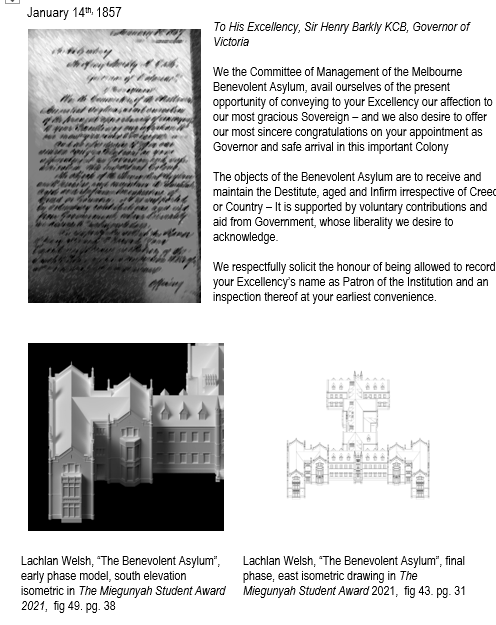
We’ve got some of his models on display case in the digital musuem. There’s also a letter from the 19th century manamgent commitee.
Here:
Meanwhile, AAMSO Olivish found some artefacts that situate the building from 1851 to 1911, and a 21st century street map in which there is no sign of the building whatsoever.
I’ll drop them here:
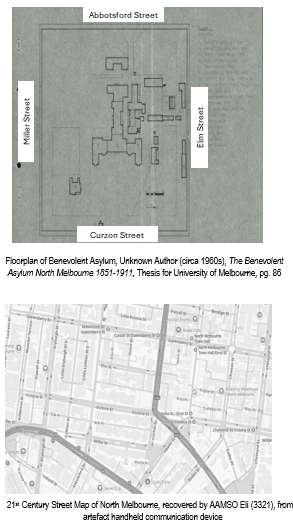
Which reminds me, Eli, how did you manage to upload that photograph from this very vantage point in the 21st century – and so quickly!
Eli
That will all become clear at the end of the show, Roger. But yes, what I can tell you is that the old Asylum site is currently the focus of re-territorialisation for the Arboreal Re-set. The red-gums and she-oaks are returning to the site as we speak, and the wattles too.
The land is reconfiguring across all of Naarm Fields – from that site to what was once called “Royal Park”. There are even signs of the Salt Lake returning. And marshlands too. Maybe the wildflowers and native bird-life will come back – curlews, ibises, ‘blue cranes’.
Roger
What about the people? There are 65,000 years of art and artefacts
Eli
Yes. A fragment in our digital museum says
…for First Nations peoples, archives existed long before invasion and colonisation. Archives are predominantly places…as well as objects and buildings .1
Roger
And these very ruins, Eli – the remnants of advanced 21st century learning – they too bear testimony to the ongoing presence here of First Nations peoples and also to their oppression and resilience.
Eli
I think this fragment refers specifically to the asylum site:
The experience of urbanisation for Aboriginal Australians is (almost entirely) absent from contemporary 19th century archives specifically connected to Hotham 2
But we know of regular gatherings near the site of the Benevolent Asylum. A Kulin Confederacy: people from the Bellarine who spoke Watha Wurrung and local Wurundjeri Woi-wurrung and Bunurong people. Most were eventually forced onto missions and reserves, far away from white settler towns. But not without resistance
Roger
And in settler documents and letters, AAMSO Olivish found numerous references to Aboriginal groups living in the Hotham area. There are recounts of everyday, sometimes tentative, interactions between local people and colonial settlers within ‘a racially charged and violent frontier’ 3.
Which suggests to me that there was a conscious attempt to erase the ongoing presence and affiliations of non-white others from the colonial archives? Colonial good will built on a mountain of wilful ignorance. We could say Nettleton’s image of the asylum invokes a silence to be interrogated.4 A monument to human dereliction and benevolence
Eli
And there was never enough benevolence to go round. Olivish found evidence people deemed “undeserving” of colonial benevolence. Some were sent gaol. Charged with “destitution” . Others are off the public record. Out of sight.
Roger
Indeed. Listen to this:
For North Melbourne’s town leaders, having the Benevolent Asylum removed was important to the town’s reputation. It’s inmates represented the antithesis of the successful colonist. 5
Eli
Roger, it might be time to bring Lachlan’s voice into the discussion.
Music File 2: AAMSO ‘Start Segment’ Music. 10 seconds
Roger
Lachlan Welsh,welcome to The AAMSO Pods.
Are you there?
Eli
Hello Lachlan! We’re not sure how long we’ve got. Let’s start with a question about your impressions of The Benevolent Asylum as colonial architecture…
Lachlan
Thanks guys. I can hear you loud and clear. So, this particular building was the first of its kind in that particular area but not unique in terms of buildings going up elsewhere in the colony. I considered the Benevolent Asylum as representative of spatial thinking and attitudes about material aid. For me the architecture serves as an anchor point for bigger questions about the relationship between what the colonial was, and what it imagined itself to be.
Eli
A grand home for the poor?
Lachlan
Yes, but for the entire sixty years that building existed, it was chronically underfunded, always overcrowded, and required constant repairs. As you can see in my models several new wings were added as ongoing extension work.
Roger
Colonial aspirations didn’t match colonial realities?
Lachlan
Maybe the idea of it evolved from good intentions – in response to obvious and desperate need. But the building itself also had an ideological function. You could say it became somewhat of a façade, masking very real problems in the colony By the time Whelan the Wrecker arrived on the site, the notion of a basic government welfare system had replaced a reliance on secular philanthropy.
Eli
We love your 3D models and the physical model of the entire building complex.
Lachlan
Thanks. I used images and floor pla-
Roger
Hang on … that’s strange… Lachlan, if you can hear us, there seems to be a glitch in the connection, we’re working on it, but meanwhile, thanks for lending us your voice!… Oh. Now Eli’s gesturing. What?
Music File 2: AAMSO ‘Start Segment’ Music. 20 seconds
So while we’re waiting for Eli, let me acknowledge all the messages of support we’ve received from you out there – from the Xenial Hubs on the western plains, from the Treaty Towers along the eastern sideboard, and even from Satellite Hubs that pick up our radio frequency. We are s-
Eli
Quick ! Roger! Listen…
Voice from Device
Hello? Hello! This is AAMSO 17324354 [X]
Calling from the ‘Melbourne’ area.
It’s the year 2033.
Roger
Oh. I know that AAMSO reference number! Is that you Magda? Magda. Magda!
Voice from Device
Yes! It’s me. Is that you Rosalie?
Roger
Yes! Oh my hack! I can’t believe it. Is Renny there with you?
Voice from Device
Sorry to say no.
We separated in the 19th century.
A storm at sea.
But don’t worry. They’ll be somewhere in time, just like I am – and you are.
Roger
Oh. Oh! I can’t believe it. Not a word or a sign for so long. How are you?
Voice from Device
I’m ok! But my manifest chip is wearing away and I’m aging rapidly.
I’ve stopped running from the Search & Rescue teams.
It’s time to get back into the AAMSO Time Bubble.
Why don’t you two join us there?
Roger
I was going to join the Salvage Teams in Alpha Centauri.
Eli
Looks like we can either travel through space or travel through time, Roger.
Roger
Or stay here and keep d-woah! aaggh!
What’s going on outside?
Wait there….
Eli
Magda, we’ll have to get back to you. Something’s come up here – or come down! But stay on the line….we’ll be back as soon as we’ve checked it out…
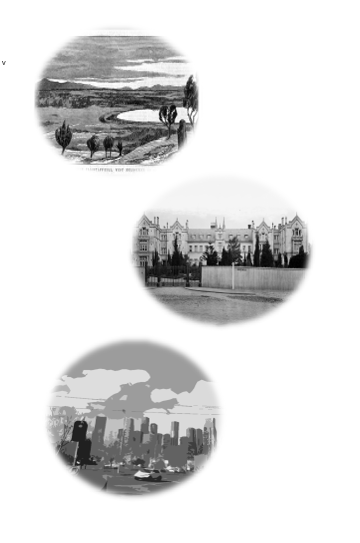
Detail: Georgiana McRae, Original Flagstaff, 4 September 1841. McRae Homestead Collection. National Trust of Australia (Victoria)
Detail: American and Australian Photographic Company, Benevolent Asylum, Hotham, Melbourne, Mitchell Library, State Library of NSW.
Detail: AAMSO Eli, 21st century Vantage Point of Benevolent Asylum Site, circa 3321
Footnotes
1. Jeanine Leane, 2023. “Rabbit Homework”, Rabbit No 38. Archive, pg. 138
2. Fiona Gatt, 2025. Old North Melbourne, pg. 43
3. Fiona Gatt, 2025. Old North Melbourne, pp. 43-51
4. David Wright, 2023. “Writing with the Australian Archive” Journal of Association for the Study of Australian Literature, 23.1 pg. 2.
5. Fiona Gatt, 2025. Old North Melbourne, pg. 135
 Unquiet Voices