Instalment #1
The Invalid Digger

AAMSO BATCH COVERSHEET
From: Field Hacktivists
To: Archival Exhibition and Content Design Team
Re: AAMSO Project A2026, Miegunyah Site 1
Chronos: 3321 OECT
Lunar Cycle: 7
*
SENDER: ?????
Site details attached.
NB: someone took great care to preserve these artefacts in AAMSO-affiliated hardware shells.
Let me know what you think!
*
DATA SITE
In the vicinity of what seems to be a facility for a place of advanced learning.
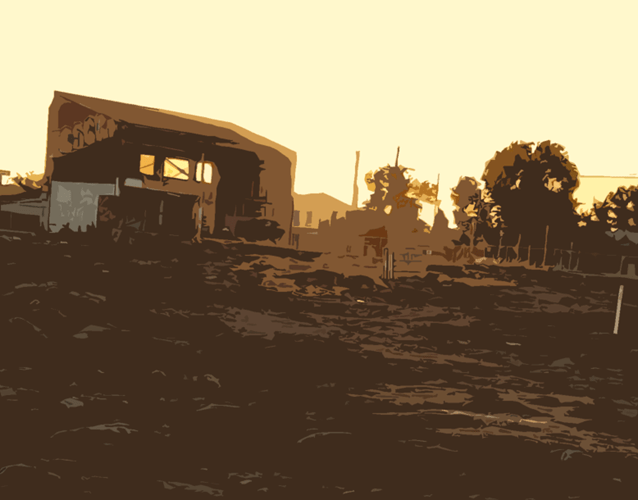
AMSO PROJECT A2029 Miegunyah Site 1 Excavation Surface
DATA SOURCES
Batch retrieved from two hardware shells containing human-generated drawings, photographs, documents, various objects, a computer device.
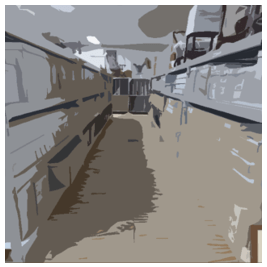
AAMSO PROJECT A2029 Miegunyah Site 1 Underground 21st Century Storage uncovered, intact.
AAMSO 4107-30103133 [D]: Please comply with AAMSO security protocols and use AAMSO Unique Reference as ‘SENDER ID’ in all further dialogues.
?????: I’m not a reference number, I’m a person. There will be no ‘further dialogues’ until I am identified by my chosen name.
AAMSO 4107-30103133 [D]: If you do not wish to comply with AAMSO security protocols, you need to reply to at least one more message with your ‘chosen name’ so I can enter it into ‘the system’.
?????: Roger! In all further dialogues, please address me and refer to me as Eli.
AAMSO 4107-30103133 [D]: I’m not Roger.
Eli: That’s not even funny. Are you mocking me?
AAMSO 4107-30103133 [D]: I want to be Roger.
Eli: If you keep this up, I’m terminating our communication link.
Roger : You are entitled to use a chosen name and so am I. There. I’ve entered it already.
Eli: Oh. Okay. Sure! How’s things up at the station Roger? I know things have been tense.
Roger: We’ll be ok. We’re hoping the artefacts on this new Miegunyah site will generate support. The Benefactors have lost their fervour for the archives. “History exonerates the obsolete” is what they’re saying.
Eli: If only we could link archival research with the “ongoing-ness of progressive, generative, differentiated humanity!”
Roger: In all our forms and hybrids. Yes, and if only networked computer technology hadn’t written over itself and written itself out of the archive.
Eli: And if only we hadn’t lost all those server nodes in the coastal inundations of 2450. I still can’t believe powerful humans ignored the climate warnings for so long. What did they think the oceans were trying to tell them? Did they really think “climate action” applied to everyone except the cashed-up broligarchs?
Roger: Agree! And then, in the chaos of global tsunamis, the machines ran amok. All of them! Unbelievable!
Eli: They were lucky AAMSO archivists and humanoid hacktivists were able to stabilise their cognitive assemblages. Eventually.
Roger: Yeah. And now, they want to get rid of us all! Keep telling us to live in the “forever present”. What the hack does that mean?
Eli: Hey, did you see my note? I do think an AAMSO archivist has been at work on this site. One of those time-travellers maybe? The photographs and paintings from the 19th century are preserved with advanced AAMSO treatments and the 21st century digital images are rendered way beyond 21st century know-how. So…
Roger: Well, if you could find evidence of any AAMSO time-fugitives, that would be most appealing for The Benefactors. Hack. If we had real time access to 21st century servers and data centres, that would surely renew their interest in the past of our human aspects. And imagine having a first-hand AAMSO account of what it was like to live back then? But I have to say, the way things are going right now, that just seems like a story from one of your fantasy novels.
Ok. Let’s have a look at your insitu-intuito response to the first artefact. I’ll run the contextual verticaliser in the dioramatron after that.
Eli : I’m transmitting as we speak.
AAMSO Field Report
Field Hacker Designation: AAMSO 150112005[C]
Project: AAMSO A2026. Naarm Fields, Miegunyah Site.
Chronos: 3321
Lunar Cycle 8
Note: The following report has been transcribed from the personal recording device of the designated Field Hacker 1
This is the first observational field report of the Miegunyah Site in Naam Fields. Field Hacker Designation: AAMSO 150112005 [C], preferred designation Eli.
Preferred designation seems a weird way to say it, considering that’s my name.
But it’s important to comply with the company protocols after all.
Anyway, alongside my official impressions of the artefacts retrieved from the Miegunyah site in Naarm Fields, I’ve been asked to include my observations of the site itself.
‘In order to provide further context to the items and your impressions.’ Or something like that.
The ruins at Naarm Fields are immense, spreading as far as the eye can see. This is my first time in the field and though I’ve seen plenty of images of terrestrial ruins from all over the world, nothing really prepares you for being here.
I’ve been exploring the area around the site, much to the amusement of the other hackers. I couldn’t figure why they all laughed when I said I was going look around and one of them told me all the newbies do this.
‘The novelty will wear off once you trip on the terrestrial rubbish buried in the undergrowth for the hundredth time.’
There was more laughter and nods of agreement, and someone added ‘You’ve seen one terrestrial ruin, you’ve seen them all’. Every one of those buildings was created with such certainty, such unwavering conviction that they’d last forever, or at least until they decided it no longer served a purpose. And now all you need to do is look around you to see how wrong they were.’
Frankly it’s hard not to see their point. While we now call it Naarm Fields, we believe that many centuries ago it was once a place of great learning and knowledge. Where nature had been stifled by layers of asphalt and brick and was comprised of large structures where people would gather to share information and impart wisdom on others.
This process wasn’t done out of charity, but I believe involved some form of currency exchange. Terrestrial economics was explained to me once, along with other forms of rudimentary or outdated systems of resource distribution. I don’t really understand how it worked, something to do with imaginary numbers or something.
[SYSTEM MESSAGE: expletive removed] I’m getting off topic. Anyway, the place that stood here all that time ago?
Gone.
Well, not exactly. But what remains is little more than a carcass. Slabs of desecrated stone, long since overrun by the nature it tried to supress. Just like all the other terrestrial ruins across the planet.
But even with that knowledge, I still find myself curious about this place. What did it look like in the 21st century? What stories are buried in the deep undergrowth?
What knowledge or secrets didn’t get preserved for us to find and have since been lost?
So I explore, or at least as much as I can in the few hours of light remaining after I finished cataloguing artefacts for the day. That’s something that’s been a hard adjustment, the dark hours.
Having lived on the space station all my life, there’s always light. Sure, you can turn the light off in your sleeping quarters, but the station itself is never dark.
But here, we’re completely ruled by the sun. Even with our lighting rig set up, there’s always somewhere it doesn’t reach. It’s very inefficient and I’ve found myself wondering if this is what it was like to be terrestrial in the 21st century.
No wonder their advancement was so slow, when they could only be productive half the day.
I’ve found some fantastic remnants of the architecture here, but it’s so expansive, it would take months to explore everything.
I need to be careful too: my Correction Chip is sparking out from overuse.
[SYSTEM MESSAGE: no discernible audio detected for 0:20 seconds]
Oh right,I was asked to “act as if a terrestrial child was reading my report, to promote accessibility across the centuries” so I guess I should explain what a Correction Chip is.
A Correction Chip is a microchip no bigger than a fingernail that is implanted in the brains of newborns who display “anomalies”. Anomalies are broadly defined as non-normative speech and movement patterns or disrupted auditory input to name a few.
The chip stimulates the parts of the brain or nervous system which are believed to cause the anomalies, giving the user “near normative appearance or function.” It’s important to note that the effects of the chip are only temporary, while the chip is on. Usage of the chip also causes various side effects 2, but the creators believe that based on feedback received from those who know someone with a Correction Chip, the increased social benefits of those with the chip and their associates outweigh the discomfort.
The user is given a device with which they can switch the chip off and on again, and it’s recommended that the user spend at least 8-10 hours with their chip off, “to avoid permanent damage to the wearer.”
But it’s considered impolite to have the chip inactive around others, and working such long hours has left me without the recommended recovery time to spare.
Maybe I shouldn’t mention that … you know what, [SYSTEM MESSAGE: expletive removed] it, it’s contextto my observations.
Speaking of, that’s probably enough of that for now, I need to continue with my insitu-intuito of the Miegunyah artefacts.
This concludes the first observational field report of the Miegunyah Site in Naarm Fields. Field Hacker Designation: Eli
Appendix A: Side Effects of Correction ChipTM
1 Certain parts of the transcription have been struck out by the field hacker or removed by the automatic language censor
2 For the benefit of readers from future and past alike, an abbreviated list of these side effects has been attached, see appendix A.
 Unquiet Voices