Tumbling Figures
This is Roger. All good for the last sequence today in the dioramatron
Aspects of horse-life reach my auditory-mind before engaging my vision.
Another newspaper tumbles across the screen. The South Australian Gazette and Colonial Register, Saturday 10 October 1846:
We have been favored by Mr Gill the Artist, who accompanied Mr Horrocks on his recent ill-fated expedition to the North-west, with the following notes of the journey, commencing on the 8th August last…
Mr Gill, the artist, in his own words:
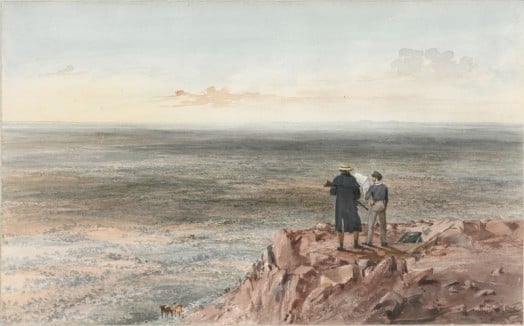
Wednesday 12th – I was engaged in rectifying some sketches. In the afternoon Mr H walked to some of the adjacent hills from which he reports the view to be very extensive.
A talking head appears on the screen. Let’s say this is an art historian. Something about the State Library of Victoria. I’m not sure if this message is from our 21st century informer or not:
The taller figure with the gun is Horrocks, the other with a sketchpad is Gill – one claiming and naming the country in front of him, the other recording it.
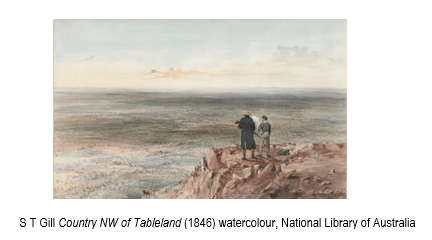
“The view from behind the figures is a romantic technique”, according to the historian, that “draws the viewer into the painting”.
But for me, it feels as though I’m standing with others and we’re watching over the entire scene unseen.
*
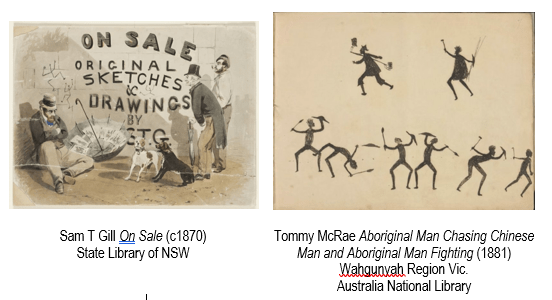
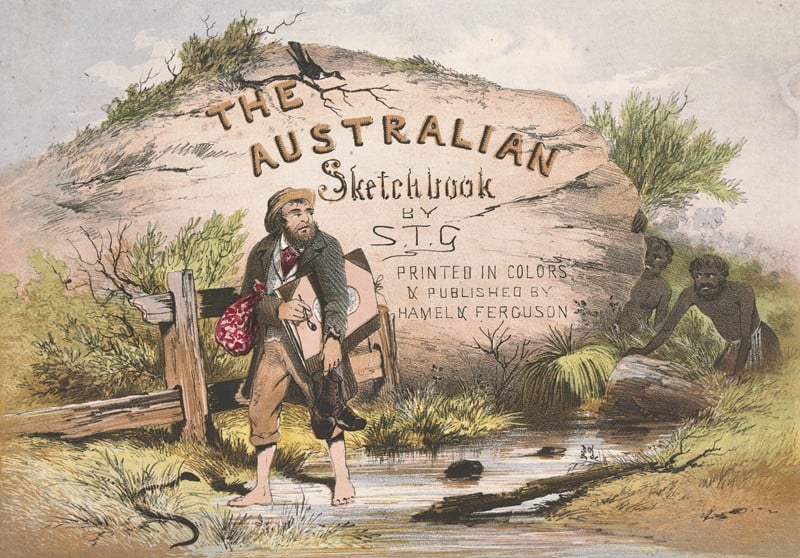
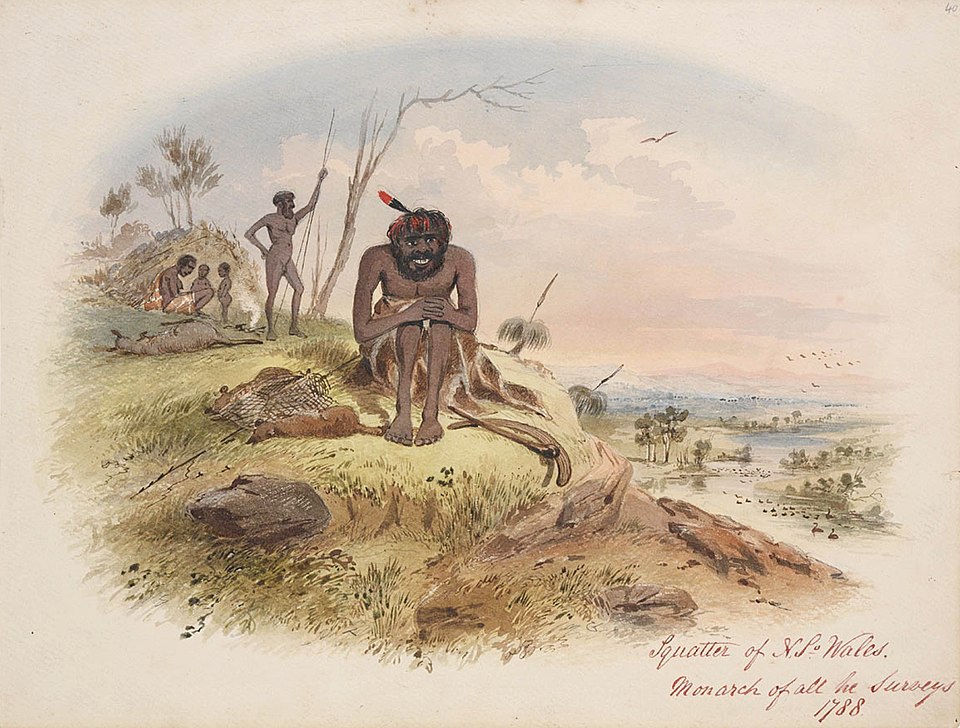
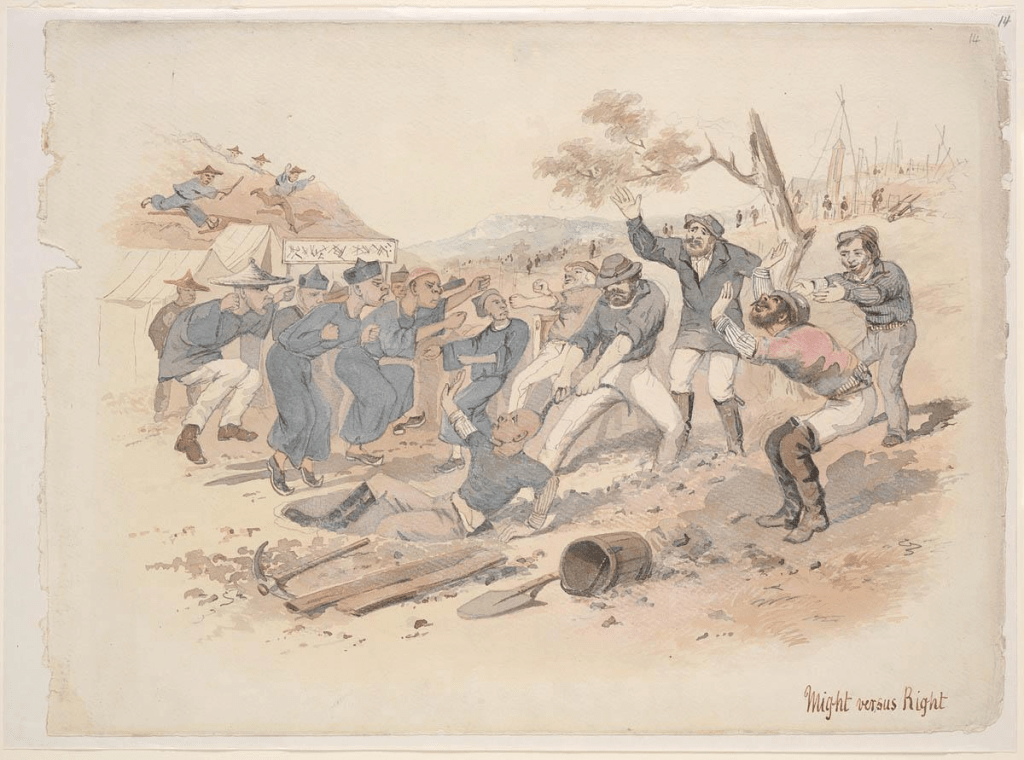
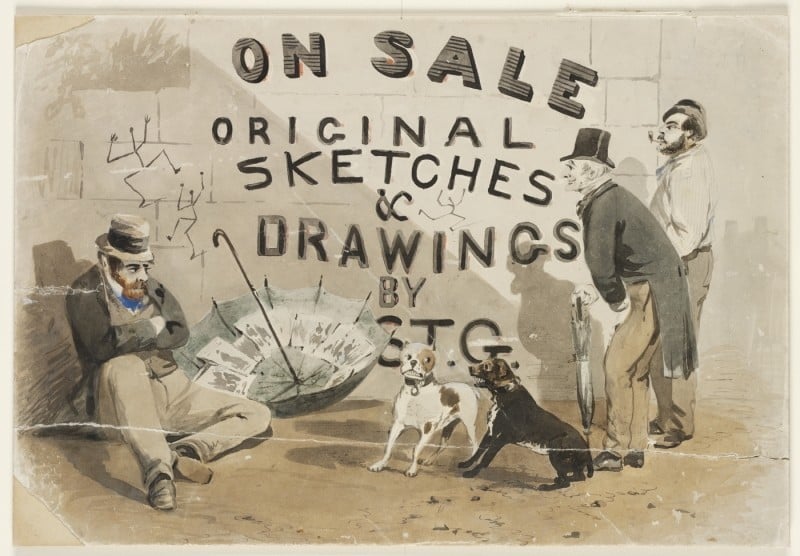
Two more paintings come into view. The historian tells us that “characterful tumbling stick figures followed Gill throughout his career”.
But I wonder if Gill was telling us of a prior and ongoing presence in the colony that could not be erased? That he was always conscious of this presence. There’s another link from our 21st century connection in ticker-text.
Now a camel enters the scene. Galumphing across the screen to become entangled, I anticipate, with the fate of Mr Gill. The artist now a witness:
“Sunday, 16th Mr H. loaded the camel with flour from the first dray, and went someway down the gully. He had great trouble with Harry (the camel), who bit at his load and wasted some of the flour…”
“Tuesday September 1st – Had walked about one hour when Kilroy, the man, called Mr H.’s attention to a bird which he saw in some scrub just before us; we stopped for Mr H. to prepare to shoot it. The camel knelt down for me to get at the shot-belt, while Mr H. drew his charge of slugs close by; the beast lurched with his load on the near side on which we stood, when the saddle hove down on the hammers of the gun; on its slipping off, the right-hand barrel, with the ramrod in it, went off, taking o
New message on the screen, perhaps from our 21st century AAMSO: THIS camel features in this exhibition as one and the same camel to arrive first in the colony[1] That camel disrupts everything. The artist now a carer:
“Wednesday, 2nd.—Mr H. appears still better. Through the night I kept his lips constantly moistened, and he swallowed a little cold water, which I got into his mouth by squeezing it from the end of a towel; this morning he took some lukewarm tea in the same way, I continue to bathe his forehead and face in warm water, and about eleven o’clock he slept a little.”
“Tuesday, 22nd.— Mr H. still worse ; his life now despaired of; Mr T. and Jimmy were to leave for town to day, but will defer it till a change takes place. Mr T. admitted to his room for the first time today. Dr Knott left for Adelaide in the afternoon. Mr H. was not expected to survive till morning.”
“Wednesday, 23rd.—Mr H. in the same state this morning ; ten o’clock Mr H. gets worse, is sinking fast; he died about half-past seven in the evening.”
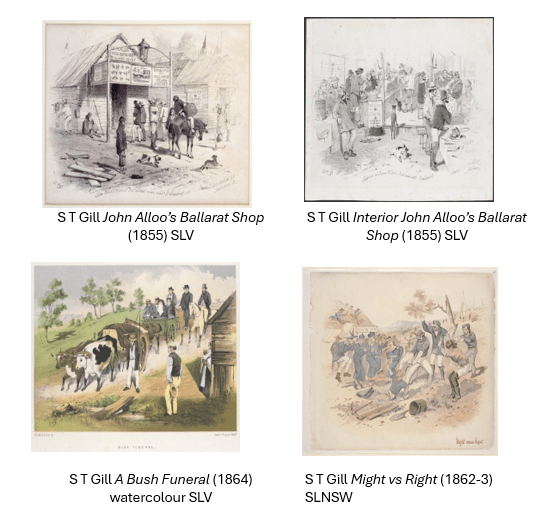
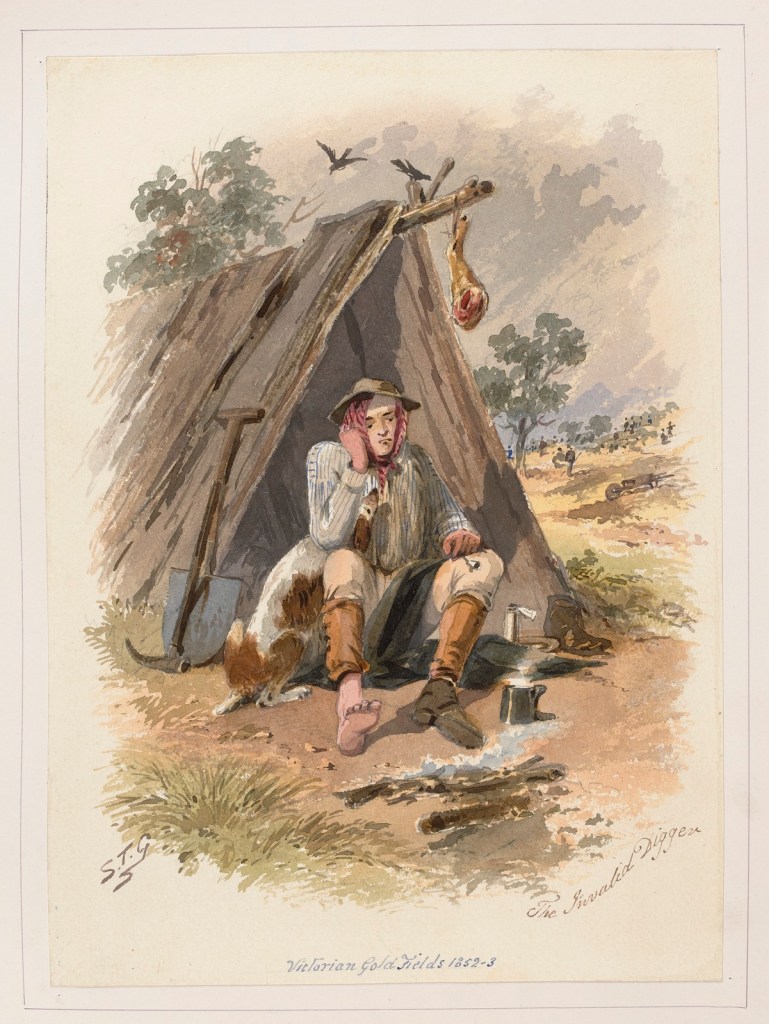
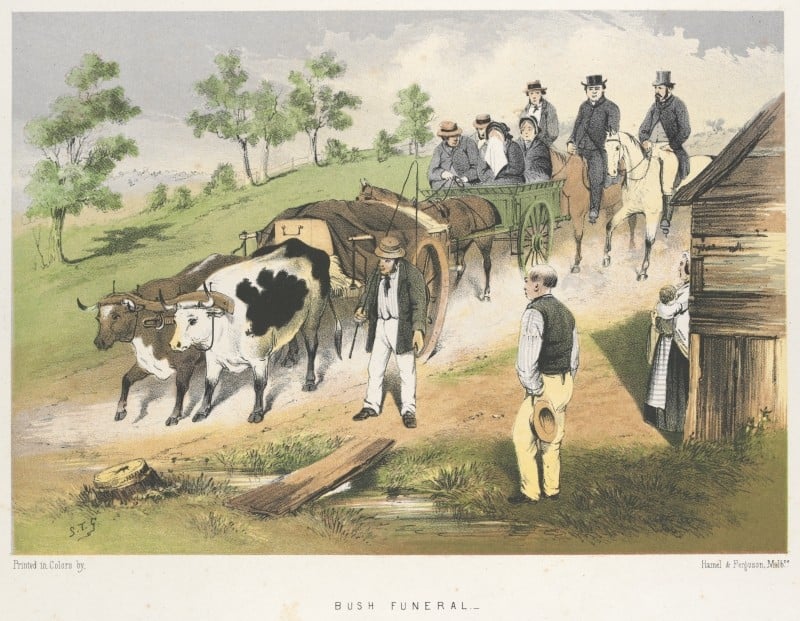
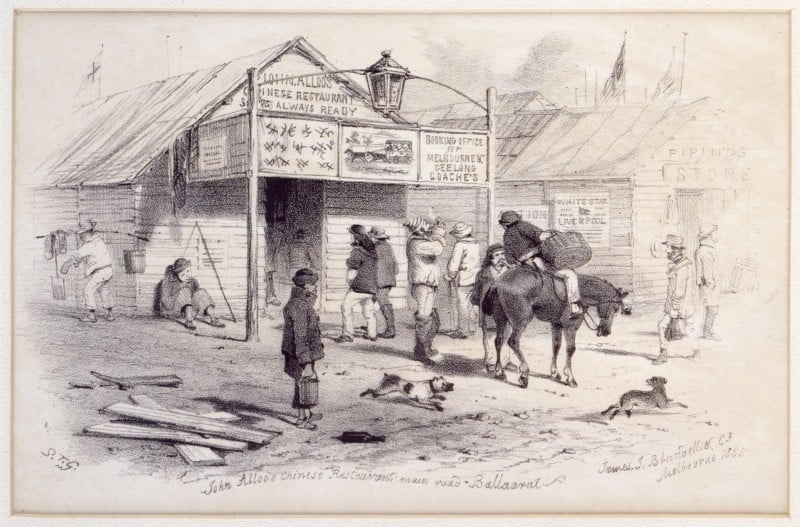
The cyclorama zooms out from the melancholy. In panoramic view: Gill as the toast of the town! There are goldfields and campsites, expeditions and panoramas, funerals, festivities, joy and despair, luck and misfortune. The images are flying across the screen with – a colonial consciousness propelling them, it seems to me, across the world in letterheads and prints.
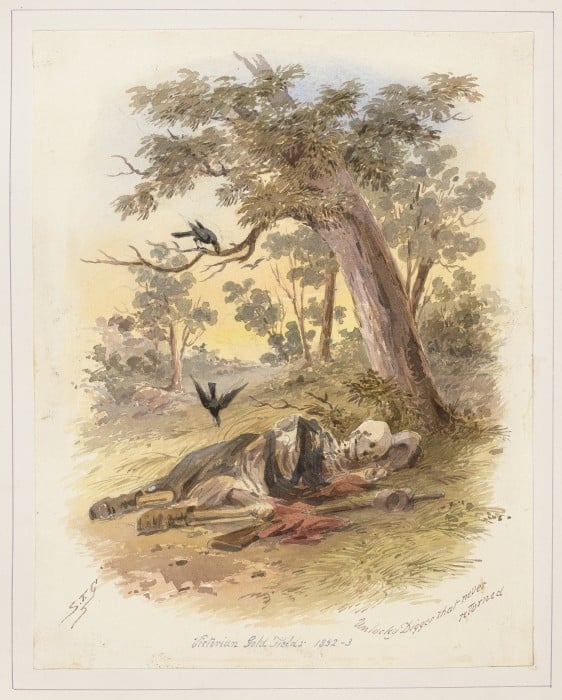
More works by Gill. Even the titles hold a mirror to colonial society: Lucky Digger that Returned (1853); Unlucky Digger that Never Returned (1869), Might vs Right (1862) and so on.
*
*
The year 1888 appears on the screen. There is our artist, Samuel Gill, lying dead, I think, on the steps of the General Post Office in Melbourne. The text reads: at peace with his anonymity, until 1911 when supporters lobbied for a hea– Oh! Hang on. The lights are on. Now they’re off. And on again. What’s going on? The dioramatron as shut down, or broken down, I don’t know which. A message arrives on the screen:
All AAMSO content designators are asked to kindly leave their workstations immediately and make their way to the Comms Platform…


 Unquiet Voices